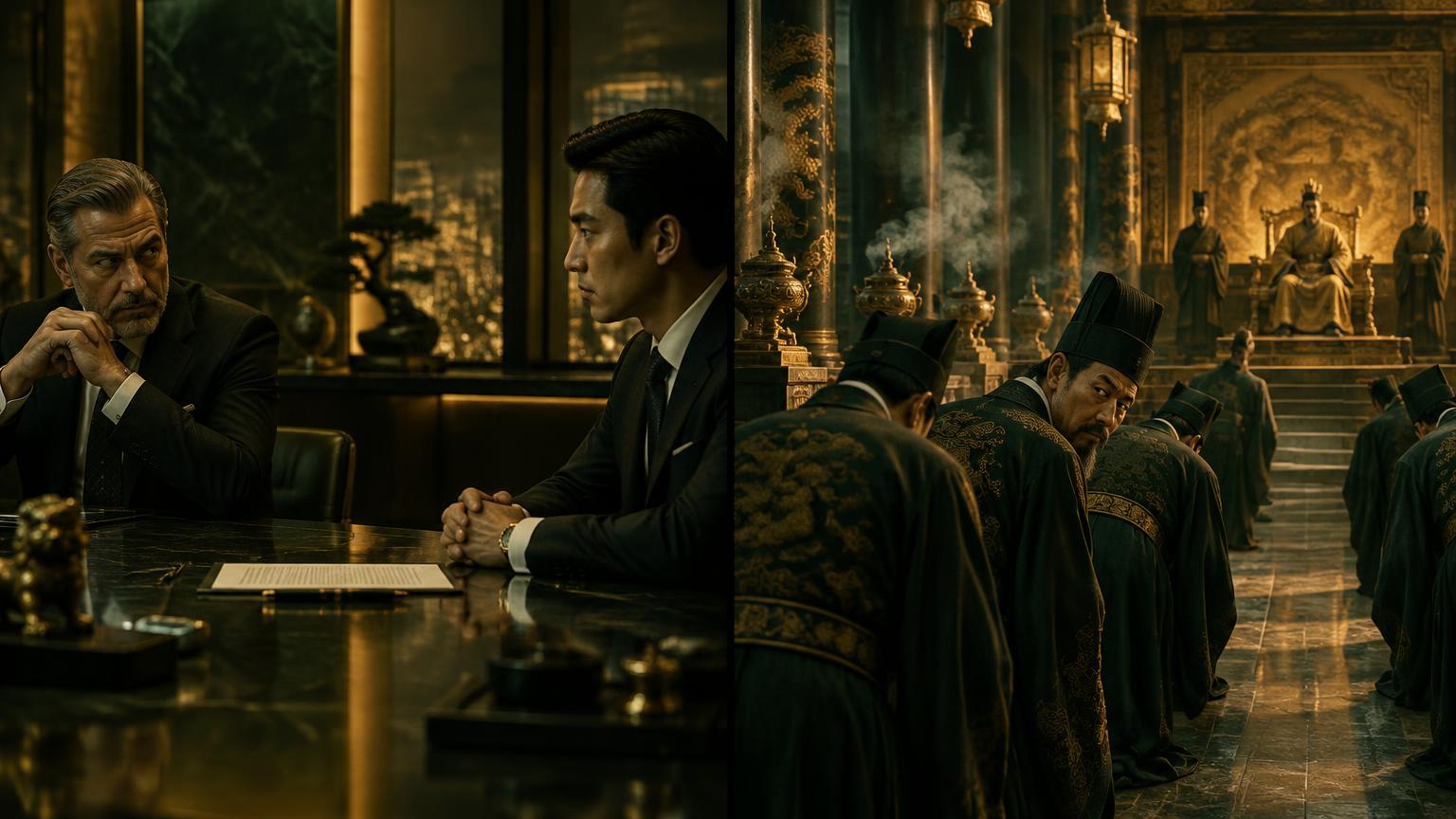
When Friends' Paths Diverge
A lesson from Guan Ning and Hua Xin
 TodayHistory
The modern dilemma
Pinning keeps chapter info in view on desktop. Unpinning returns it to the page flow. Chapter text always scrolls with the page.
This chapter scrolls with the page. Use the arrow keys or Page Up and Page Down to read. Press Tab to leave this reading area.
A close friend introduced you to your first clients when your consulting business was struggling. They spent evenings helping you prepare and asked for nothing in return. Now they are launching a paid career-coaching program and want your name on the website and a monthly session for participants.
You have seen them help people one-on-one, but you have not reviewed the new program or the results it promises. They want to grow quickly; you favor a smaller pilot before making broad claims. They see your involvement as a natural return for their earlier support. You want to honor that help, while protecting the people who might enroll because they trust your name.
Joining could give you a chance to improve the program, but it would commit time and credibility before you know enough. Refusing could disappoint a friend who has been generous. Reviewing the materials or helping privately might be useful, or might still enable a plan you cannot support. You have not promised to join, but that does not make the relationship's history meaningless.
What should you still honor, and how much of the relationship actually needs to change?
A story from history
Late Han–Early Wei · 2nd–3rd centuries CE
Pinning keeps chapter info in view on desktop. Unpinning returns it to the page flow. Chapter text always scrolls with the page.
This chapter scrolls with the page. Use the arrow keys or Page Up and Page Down to read. Press Tab to leave this reading area.
What the Mat Story Actually Tells
Guan Ning and Hua Xin were scholars whose lives crossed the late Han and early Wei periods. Shishuo Xinyu, a fifth-century collection of anecdotes, tells of them gardening together. They find gold in the soil. Guan continues hoeing; Hua picks it up, then throws it away. The account does not say he keeps it. On another occasion, while they share a mat to read, Hua puts down his book and goes out to watch someone in official dress passing in a carriage. Guan cuts the mat and declares that Hua is not his friend.
These are two occasions joined by the narrator, not a single uninterrupted scene. The collection supplies no date for them. Its sharp contrasts invite a judgment about attention to wealth, rank, and study. But Hua's momentary interest is not the same as keeping the gold, and the scene does not tell us what the two had agreed friendship required. The reported words are part of this literary account, not an authenticated transcript.
One reading treats Guan's action as a serious standard for close companionship: whom you study with may shape what you pursue. Another sees a sweeping verdict drawn from limited behavior. The story gives us no conversation about repair, no account of earlier disagreements, and no response from Hua. Those omissions do not prove that Guan was wrong; they limit our ability to turn his decision into a rule. A vivid gesture can express a boundary without establishing how broad that boundary ought to be.
Lives Beyond the Gesture
The earlier Records of the Three Kingdoms gives a less compressed setting. Volume 11 records the men's friendship and travels for study. Guan later moved to Liaodong during disorder. In 223, Hua recommended him for recruitment; Guan returned across the sea but declined the offered office. The account then records further invitations and refusals. Retirement was not simply the moment after a cut mat, and the careers cannot be arranged as the immediate rewards of one moral test.
Volume 13 records Hua holding senior Wei office and later asking to retire in Guan's favor; the emperor refused. This nomination can be read as recognition across different ways of life. It could also serve a court seeking respected recruits and an official seeking retirement. It does not prove reconciliation, continuous contact, or Hua's private motives. Nor does Guan's refusal establish contempt for Hua. Appraising someone for a position, choosing to serve, and choosing close companionship are different decisions.
The Boundary and What Remains
Read together, these texts resist making either man the whole of his most memorable scene. They are not pieces of one verified continuous story: a later anecdote and earlier biographies have different purposes and levels of detail. The mat dramatizes a break; the nomination records a form of recognition. The sources do not let us reconstruct the friendship between those moments. They do let us question the assumption that different paths require a single verdict on everything a person is worth.
There is also no recorded debt of help in the mat episode. Gratitude belongs to our modern dilemma, not to an invented explanation of Guan's action. A past kindness adds a reason to acknowledge someone and examine any promises you made. It does not tell you, by itself, which present request you should support. The question becomes more precise: what part can you no longer share, what responsibilities remain, and what forms of connection are still possible? Sometimes the answer is a limited refusal; sometimes the conflict reaches the relationship itself. Neither answer is established by copying Guan's gesture.
Records of the Three Kingdoms 11 and 13 record the friendship, Guan's refusals, and Hua's recommendation and proposed retirement. They are chapters of Chen Shou's third-century work, transmitted with later annotations. They do not independently authenticate the mat scene or establish an unbroken account of the friendship.
Shishuo Xinyu, Virtuous Conduct 11, supplies the gold and mat episodes and the reported declaration. Its fifth-century character portraits are not contemporary transcripts. The appended Weilue passage belongs to commentary and is distinct from the anecdote. The exact year and the earliest recoverable form of the story remain uncertain.
Choosing the scope of a boundary is a modern reading of the contrast between separation and recognition. Neither a debt of past help nor an obligation to repay one is established in the mat episode. Gratitude adds a condition to the modern comparison; no reconciliation, continuing contact, or universally correct decision is inferred.
Discover the lesson
Pinning keeps chapter info in view on desktop. Unpinning returns it to the page flow. Chapter text always scrolls with the page.
This chapter scrolls with the page. Use the arrow keys or Page Up and Page Down to read. Press Tab to leave this reading area.
“A limit on shared action need not be a verdict on an entire friendship.”
- i
Define the Scope of Your No
The mat story moves from conduct during shared study to ending a friendship. Before doing the same, name the actual disagreement: a goal, a method, a public endorsement, or an ongoing pattern. Decide which forms of involvement it prevents. A narrower refusal may preserve something worthwhile; repeated pressure or a serious conflict may require more distance. Check whether the boundary protects a consistent principle or merely avoids an inconvenient obligation. You need not condemn the whole person to explain a limit on this particular undertaking.
- ii
Make Gratitude Concrete
Hua's recommendation and Guan's refusal show that recognition and taking the same path need not coincide; they do not establish how either man repaid a favor. In your own relationship, acknowledge the specific help and identify any promise still due. Consider a contribution you can freely and honestly make: time, practical assistance, or recognition where appropriate. An alternative should be useful to the other person, not just relieve your guilt. They may decline it. A sincere thank-you does not cancel an explicit commitment, and an old kindness does not specify every future one.
- iii
Consider Who Else Your Help Commits
Hua's proposal concerned an office, so the choice involved a ruler and public responsibilities as well as two acquaintances. A modern favor may likewise involve people outside the friendship. Lending your name to a venture can influence customers, colleagues, or donors who know nothing of your private debt. Ask what they would reasonably understand your involvement to mean. Personal gratitude cannot supply evidence for claims you have not checked. If a limited contribution remains possible, make its scope clear and ensure it does not quietly enable the part you oppose.
Some requests are harmless differences in preference; others expose people to serious harm. A closer relationship is not always repairable or safe, and an alternative favor may still enable what you oppose. Existing promises and responsibilities need attention even when future cooperation ends. Do not use this anecdote to label ambition corrupt, retirement superior, or a friend unworthy after one distraction. Nor should gratitude require repeated consent under pressure. The texts offer material for examining the size of a boundary, not a test that determines how much friendship you must preserve.
Your decision
Choose what you would do. Each choice reveals a different perspective — none is simply right.
A friend helped you through a hard time years ago. Now your goals no longer align, and they expect you to support a plan you disagree with.